AI Search Readiness: What Your Score Really Means
When someone asks ChatGPT or Perplexity a question about your industry, does your business appear in the answer? For most companies, the honest answer is: they have no idea.
Traditional SEO tools measure how well you rank on Google. But a growing share of your audience never reaches Google at all. They ask an AI engine directly and get a synthesised answer - often without a single link to click. If your content isn't structured for AI extraction, you're invisible to these people.
That's what the AI Search Readiness score measures. Not whether you will appear in an AI-generated answer (nobody can guarantee that - the responses are inherently variable), but whether your content is structured in a way that gives you the best possible chance.
Why AI search readiness matters now
The numbers are hard to ignore. According to SparkToro's 2024 research, over 58% of Google searches end without a click. AI-powered answers are accelerating that trend.
ChatGPT has over 200 million weekly active users. Perplexity processes millions of queries daily. Google's own AI Overviews now appear on a growing percentage of search results pages. These engines don't just crawl your page and index keywords. They try to understand your content, extract facts, and decide whether your information is trustworthy enough to cite.
The sites that get cited share common structural patterns. That's what we measure.
The six dimensions
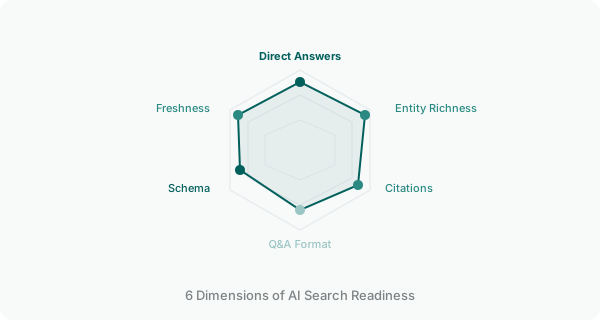
OptimAI's AI Search Readiness score is built from six dimensions. Together they carry 40% of your total score - the single largest category, because we believe this is where the web is heading.
One important thing to understand: all six AI Search dimensions are keyword-agnostic. They measure the structural quality of your page - how extractable, data-rich, well-sourced, and well-structured your content is - regardless of what keyword you're targeting. This isn't about keyword stuffing or matching a search phrase. It's about whether your page is the kind of content AI engines want to cite.
In fact, 65% of your total OptimAI score is keyword-independent. The AI Search, Technical, and Performance sections all evaluate your page as a standalone piece of content. Only a handful of dimensions - primarily in Content and On-Page SEO - check whether your target keyword appears in the right places. This means your AI Search Readiness score is a general page quality rating, not a keyword-specific ranking signal.
1. Direct Answer Potential
Can an AI engine extract a clear, concise answer from your content? Pages that bury their key points inside long paragraphs or hide them behind vague headings score poorly here. AI engines favour content that leads with the answer, then supports it with detail.
What helps: Clear topic sentences. Definitions near the top of relevant sections. Summaries before deep dives. Think about how you'd answer the question in one sentence - then make sure that sentence actually appears on the page.
2. Entity Richness
Entities are the named things in your content - people, companies, products, places, concepts. AI engines build knowledge graphs from entities and their relationships. A page that mentions "our software" scores lower than one that says "OptimAI, our AI-powered SEO audit tool built by thus(digital)".
What helps: Name things explicitly. Use full company names, product names, and industry terms rather than pronouns or generic descriptions. Link entities to authoritative sources where possible.
3. Citation Worthiness
Would an AI engine trust your page enough to cite it? This dimension looks at signals of authority and credibility: original data, specific numbers, named sources, methodology descriptions, and clear authorship. AI engines are trained to prefer authoritative sources over opinion pieces.
What helps: Include original research, case studies with real numbers, named expert quotes, and links to primary sources. Make your authorship and credentials visible.
4. Q&A Format Alignment
Most AI queries are questions. If your content is structured as answers to specific questions, it's much more likely to be extracted. This dimension checks whether your headings match common query patterns and whether the content beneath them directly answers the implied question.
What helps: Use question-format headings where natural ("How does X work?", "What is the cost of Y?"). Include FAQ sections with schema markup. Structure content so each section answers one clear question.
5. Structured Data (Schema)
Schema markup is machine-readable metadata that tells search engines and AI engines exactly what your content represents. A page with FAQ schema, Article schema, or Organisation schema gives AI engines structured data to work with instead of forcing them to parse raw HTML.
What helps: Add relevant schema types - FAQPage for Q&A content, Article for blog posts, Product for product pages, LocalBusiness for local services. Use JSON-LD format (Google's preferred method). Validate with Google's Rich Results Test.
6. Content Freshness
AI engines prefer recent information. A page last updated three years ago is less likely to be cited than one updated last month - especially for topics where accuracy matters. This dimension checks publication dates, last-modified signals, and temporal references in your content.
What helps: Include visible dates on your pages. Use dateModified in your schema markup. Update content regularly, even if it's just refreshing statistics or adding recent examples. Remove obviously outdated references.
What a high score means (and what it doesn't)
A high AI Search Readiness score means your content is well-structured for AI extraction. It means that when an AI engine processes your page, it can easily identify your key points, understand your entities, and assess your credibility.
It does not guarantee you'll appear in AI-generated answers. Those responses change with every query, every user, and every model update. An AI engine might cite your competitor today and cite you tomorrow, even if your content hasn't changed.
Think of it like dressing well for a job interview. It doesn't guarantee you'll get the job. But showing up in pyjamas guarantees you won't.
A low score, on the other hand, is a much stronger signal. If your content isn't structured for AI extraction, you're effectively invisible to a growing share of your potential audience. And unlike traditional SEO - where you might still get some long-tail traffic even with a mediocre page - AI engines tend to either cite you or not. There's no "page 2" of an AI answer.
How AI search readiness differs from traditional SEO
Traditional SEO optimises for keyword matching and link authority. You target a keyword, build backlinks, and climb the rankings. The page with the strongest domain authority and best on-page signals generally wins.
AI search readiness is different. AI engines don't rank pages - they synthesise answers from multiple sources. The factors that matter are:
- Extractability - can the engine pull a clean answer from your content?
- Trustworthiness - does your page look like a credible source?
- Specificity - do you name things explicitly rather than using vague language?
- Structure - is your content organised in a way machines can parse?
- Freshness - is your information current?
You can have perfect traditional SEO - a page ranking #1 on Google - and still score poorly on AI Search Readiness if the content is written for humans scanning headings rather than machines extracting facts.
The good news is that optimising for AI readiness almost always improves your traditional SEO too. Clearer structure, better schema, more specific content, and fresher updates help both channels.
Quick wins to improve your score
If your AI Search Readiness score is in amber or red territory, here are the highest-impact changes you can make:
- Add FAQ schema - if you have any Q&A content on your page, wrap it in FAQPage schema. This is the single fastest way to improve your structured data score.
- Lead with answers - for each section of your page, put the key point in the first sentence. Don't make readers (or AI engines) dig through context to find the answer.
- Name your entities - replace "our product" with the actual product name. Replace "the company" with the company name. Be specific.
- Add dates - visible publication and update dates, plus
datePublishedanddateModifiedin your schema. - Include original data - even simple statistics from your own experience ("we tested 50 pages and found...") make your content more citable than generic advice.
How we calculate the score
OptimAI's scoring is fully deterministic - no AI involved in the scoring itself. We parse your page content, analyse its structure, check for schema markup, evaluate entity density, and measure alignment with known AI-friendly patterns. Every dimension produces a score from 0 to 100, and the weighted average gives you your AI Search Readiness score.
The AI Search Readiness category carries 40% of your total OptimAI score. The remaining 60% covers Content Quality (24%), On-Page SEO (20%), Technical Health (10%), and Performance (6%). We weight AI readiness heavily because it's the fastest-growing channel and the one where most businesses are furthest behind.
Beyond the score, every OptimAI scan also runs live AI visibility checks - we actually query ChatGPT and Perplexity about your target keyword and check whether they mention or cite your page. That's not part of the readiness score (it's too variable to score reliably), but it gives you a snapshot of your current visibility.
The takeaway
AI search isn't replacing Google overnight. But it's growing fast, and the businesses that prepare now will have a structural advantage over those who wait. The six dimensions we measure aren't mysterious - they're the same patterns that make content clear, credible, and well-structured for any audience.
The difference is that AI engines reward these patterns more consistently than traditional search ever did. Good structure used to be nice to have. In the AI search era, it's the price of admission.
Want to check your AI Search Readiness score?
Run a Free AI SEO Audit10 free page scans. No credit card required.