
David Beats Goliath: How a Tiny Site Outranks Semrush on Google
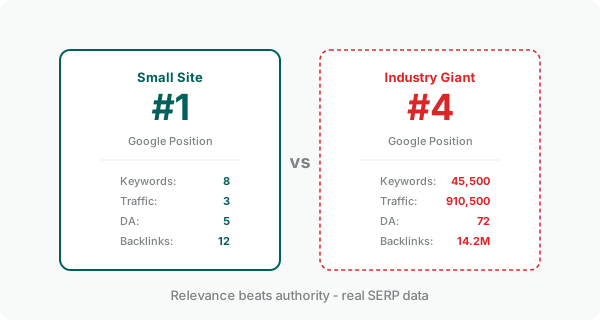
There's a widely held belief in SEO that domain authority is king. That backlinks are everything. That a small site simply cannot outrank a large, established one. We just found real-world SERP data that proves this wrong - and the implications are significant for every small business trying to compete online.
The data that surprised us
We ran an OptimAI scan on our own landing page for the keyword "free AI visibility audit." The SERP Intelligence panel pulled back the top 10 Google results with full domain metrics. Here's what we found:
| # | Domain | Keywords | Traffic | Backlinks |
|---|---|---|---|---|
| 1 | govisible.ai | 8 | 3 | 12 |
| 2 | alli.io | 155 | 206 | 284 |
| 3 | seoptimer.com | 17,200 | 160,500 | 1.4M |
| 4 | semrush.com | 45,500 | 910,500 | 14.2M |
| 5 | ahrefs.com | 31,900 | 589,000 | 11.8M |
Read that again. A site with 8 total keywords and 3 monthly visitors is sitting at position 1. Semrush - with 45,500 keywords, 910,500 monthly visitors, and 14.2 million backlinks - is at position 4. Ahrefs, with similar scale, is at position 5.
This isn't a fluke. It's how modern Google actually works.
Why domain authority doesn't guarantee rankings
Domain authority (DA) is a third-party metric invented by Moz. Google has repeatedly stated they don't use it as a ranking factor. That hasn't stopped an entire industry from treating it as gospel.
DA measures a domain's overall backlink profile and visibility. It's a useful signal for general domain strength, but it tells you nothing about whether a specific page is the best answer for a specific query. And that's what Google cares about.
Here's the thing: Semrush ranks for 45,500 keywords. That's an enormous breadth of content. But for this particular query - "free AI visibility audit" - their page isn't the most relevant result. The small site's page is.
What actually wins in Google
Google's ranking algorithm considers hundreds of factors, but for any given query, three things matter most:
1. Topical relevance
Does the page directly address the search query? A page built entirely around "free AI visibility audit" will outperform a generic tool page that mentions it in passing. The small site's entire domain is about AI visibility. Every page, every heading, every internal link reinforces that single topic. Semrush's page about it is one of thousands.
2. Content depth and specificity
Google rewards pages that comprehensively answer the query. If someone searches "free AI visibility audit," they want to understand what an AI visibility audit is, why it matters, and ideally run one. A dedicated page that covers all of this will outrank a broader tool page that lists "AI visibility" as one of twenty features.
3. Search intent match
The word "free" in the query signals intent - the user wants to try something without paying. A page that leads with a free tool and explains the value proposition matches that intent precisely. A page that leads with pricing tiers and enterprise features doesn't.
The backlinks myth
The position 1 site has 12 backlinks. Semrush has 14.2 million. That's a factor of over one million.
Backlinks absolutely matter for SEO. But their importance is relative to the competitive landscape for a specific query. For a highly specific, long-tail keyword like "free AI visibility audit," the bar for backlinks is much lower than for something like "SEO tool." There simply aren't millions of pages competing for this exact phrase.
This is the leverage point that most small businesses miss. You don't need to compete for the broad, high-volume keywords. Find the specific queries your audience is actually searching for, create the best possible content for those queries, and you can rank above sites a thousand times your size.
The flip side: ranking #1 doesn't mean your page is good
We found an equally revealing example going the other direction. We scanned seoptimer.com - one of the more popular free SEO audit tools - for the keyword "free seo audit." They're sitting at position #1 on Google, ahead of Semrush, Neil Patel, Ahrefs, and every other major player.
| # | Domain | Keywords | Traffic |
|---|---|---|---|
| 1 | seoptimer.com | 5,917 | 176,534 |
| 2 | semrush.com | 45,511 | 910,451 |
| 3 | neilpatel.com | 785 | 7,160 |
| 7 | seositecheckup.com | 2,983 | 208,679 |
| 8 | ahrefs.com | 22,944 | 316,669 |
So SEOptimer - with a fraction of Semrush's domain metrics - is beating all of them. Same David vs Goliath pattern. But here's the twist: when we ran their page through our full OptimAI scorecard, they scored just 46 out of 100.
Their section scores tell the story: AI Search Readiness 28, Performance 52, On-Page 54, Content 62, Technical 73. The page ranks well because of exact topical match and years of accumulated authority for this specific query. But the actual page quality? Amber across the board, with AI readiness deep in the red.
This matters because it reveals vulnerability. A page that ranks #1 with a score of 46 is beatable. Google rewards relevance and authority today, but content quality, page speed, and AI readiness are increasingly weighted. A competitor who builds a genuinely better page for that query - higher content depth, stronger AI readiness, faster load times - has a real shot at taking that spot.
Two lessons from one dataset:
- Small sites can outrank giants - topical focus and relevance beat raw domain scale
- Current rankings mask page quality gaps - a high position doesn't mean the page is good, it means nobody better has shown up yet
What this means for your business
If you've been told you can't rank because your domain authority is too low, or because you don't have enough backlinks, or because your competitors are too big - this data proves otherwise. Here's what to take from it:
- Specificity wins. Don't try to rank for "SEO tool." Rank for the specific thing your ideal customer is searching for. The more specific the query, the less competition, and the less domain authority matters.
- Relevance beats scale. A 5-page site that's entirely about one topic can outrank a 50,000-page site for queries within that topic. Google sees the focused site as more authoritative on that specific subject.
- Content quality is the great equaliser. You can't buy 14 million backlinks overnight. But you can write the most useful, comprehensive page for your target keyword today. And that's often enough.
- AI search is shifting the game further. AI engines like ChatGPT and Perplexity are even more focused on content relevance than traditional search. They synthesise answers from the most relevant sources regardless of domain size.
How to find your David vs Goliath opportunities
Every business has these opportunities hiding in plain sight. The process is straightforward:
- Identify your niche keywords. What specific phrases would your ideal customer type into Google? Not the broad category - the specific question or need.
- Check the SERP. Run an OptimAI scan with that keyword. The SERP Intelligence panel shows you exactly who's ranking, their domain metrics, and estimated traffic. If you see big sites ranking with generic pages, that's your opening.
- Create the best page for that query. Make it comprehensive, specific, and directly useful. Answer the question fully. If the query implies the user wants to do something (like run an audit), let them do it right there.
- Measure and iterate. Use the traffic-light scorecard to identify gaps in your content quality, on-page SEO, and AI search readiness. Fix the red and amber items. Rescan. Repeat until you're green across the board.
The bigger picture
The SEO industry has spent years telling small businesses they need expensive tools, months of link building, and professional consultants just to get on page one. For competitive head terms, that might be true. But for the specific, high-intent keywords that actually drive your business? The data says otherwise.
A site with 8 keywords is outranking a site with 45,500. A site with 3 monthly visitors is beating one with 910,500. Not through tricks, not through manipulation - through simple, focused relevance.
The playing field is more level than anyone told you. You just need to pick the right fights.
Want to find your ranking opportunities?
Run a free scan to see who you're competing against - and where you can win.
Run a Free AI SEO Audit10 free page scans. No credit card required.