OptimAI - Free AI visibility audit tool OptimAI

Free AI visibility audit for your website

Find out if ChatGPT, Perplexity and Google AI engines can find you

Our AI visibility audit checks 98 metrics across 20 dimensions in 30 seconds. Paste your URL and keyword. Get your AI visibility score, a complete SEO scorecard, and the exact opportunities you're missing.

60% of Google searches now end without a click - and that rises to 93% when Google's AI Mode is active. Meanwhile, 61% of small businesses aren't investing in SEO at all. The ones who do are paying agencies $497/month on average - often without knowing if it's working.

No card required. See pricing or try it free now.

How the AI visibility audit works

1

Paste your URL and keyword

Enter any web page (including your competitors) and the keyword you want to rank for. That's it - no setup, no configuration, no learning curve.

2

We score across 5 categories

In 30 seconds, we analyse AI Search Readiness, Content Quality, On-Page SEO, Technical Health, and Performance - pulling from multiple data sources to build a complete picture.

3

Get your scorecard and action plan

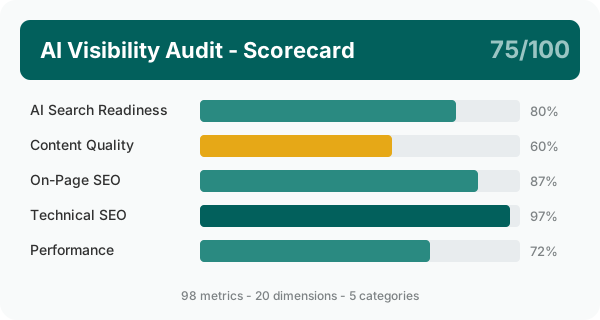
Traffic-light ranking with a score out of 100 for every metric, each of the 20 dimensions, and each category - all rolling up to your grand total. Then specific recommendations prioritised by impact, so you know exactly what to fix first.

AI visibility audit scorecard showing traffic-light scores across 5 SEO categories - placeholder, real screenshot coming

What we measure

Five categories, 20 dimensions, one clear score

AI Search Readiness

40%

Are AI assistants finding and citing your content? We check Perplexity, ChatGPT, and Gemini - then score your content for structured data, Q&A patterns, entity richness, citation worthiness, and freshness signals.

What nobody else measures

What is an AI visibility score?

Your AI visibility score measures how well your content performs in AI-powered search engines. The shift is already happening: AI referral traffic grew 123% in 2025, and AI chatbot sessions hit 1.2 billion monthly visits in 2026. ChatGPT alone has over 1 billion monthly visits with 2.5 billion daily prompts. Perplexity handles 780 million monthly queries and is targeting 1 billion per week. And this isn't just cannibalising Google - 70% of ChatGPT prompts are unique queries that users rarely search on Google. It's entirely new search behaviour. The kicker? AI search traffic converts at 14.2% compared to Google's 2.8% - 5x more valuable.

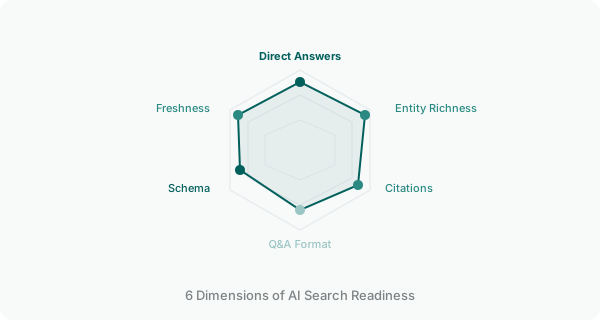
We tested six dimensions of AI readiness across hundreds of pages. For example, Direct Answer Density checks if your content answers questions clearly. Entity Richness checks if topics and names are well-structured. Citation Worthiness asks: would an AI engine trust your page? Plus Q&A formatting, Schema.org markup, and freshness signals. We break all six dimensions down in our guide to understanding your free AI visibility audit score.

Google's AI Overviews, ChatGPT, and Perplexity each pull from web content differently. A 5,000-prompt study by Previsible found that 82% of frequently cited pages use explicit entity naming. 71% keep paragraphs under 4 lines. Structured data directly improves AI visibility. Run a free scan to see where you stand and what to fix.

Content Quality

24%

Keyword usage, content depth, readability, and heading structure. Is your content actually good enough to rank - or just good enough to exist?

How does content quality affect search rankings?

Content quality scoring goes beyond keyword counting. Studies consistently show that top-ranking pages average 1,400-2,000 words. They use their target keyword in 70-80% of key HTML positions. They keep a Flesch readability score between 50 and 70. Our analysis covers keyword placement across 5 positions, content depth, readability grade, and heading hierarchy.

Comprehensive content outperforms thin pages by a wide margin. Our SEO scorecard identifies thin content, poor structure, and missed keyword opportunities. Then it tells you what to improve - and why it matters for both traditional SEO and AI search optimisation. See how the scan-fix-rescan free AI visibility audit workflow turns these insights into measurable score improvements.

On-Page SEO

20%

Meta tags, images, internal links, external links, and site structure. The fundamentals that most pages still get wrong.

What on-page SEO elements matter most?

On-page SEO covers the HTML elements that tell search engines what your page is about. We check 5 areas, such as meta title length, description length, image alt text, internal links, and URL paths. Research from Ahrefs found that most pages have meta descriptions that get cut off in search results. That costs clicks. And 59.5% of websites are missing H1 tags entirely, while 51.3% have multiple H1 tags - both of which confuse search engines and AI crawlers.

These basics still trip up most websites. Google's SEO Starter Guide calls them the foundation of any search strategy. AI engines also parse your page structure to build answers. Good internal links pass authority and help crawlers understand your content. Even small technical fixes can produce big score jumps - we saw a 30-point improvement from a single font optimisation on our own free AI visibility audit.

Technical SEO

10%

HTTPS, structured data, crawlability, accessibility, and best practices. The plumbing that search engines need to index you properly.

Why does technical SEO still matter for AI search?

Technical SEO ensures search engines can crawl and index your pages. We audit HTTPS, structured data, robots.txt, canonical tags, and accessibility. Google's crawling docs confirm it: if search engines can't reach your content, it won't rank. Period.

Without solid technical foundations, even great content stays invisible. Our checks use the same signals search engines evaluate. You see your pages exactly as they do.

Performance

6%

Core Web Vitals, page speed, and resource optimisation. Fast pages rank higher and convert better.

How does page speed affect SEO and conversions?

Page speed directly impacts rankings and conversions. Google's research shows that going from 1 to 3 seconds load time increases bounce probability by 32%. We measure Core Web Vitals: Largest Contentful Paint (under 2.5s), Cumulative Layout Shift (under 0.1), and Interaction to Next Paint (under 200ms). Only 33% of websites currently meet all Core Web Vitals standards - meaning two thirds of the web is leaving rankings and conversions on the table.

Pages meeting all three targets are 24% less likely to lose users. We pull real data from Google PageSpeed Insights for every scan. It's the same data Google uses to judge your page.

Beyond the scorecard

Every scan includes intelligence panels you won't find anywhere else

AI Visibility Check

Live test: does ChatGPT, Perplexity, or Gemini mention your site when asked about your keyword? See exactly where you stand in AI search.

Why is AI visibility the new SEO battleground?

We query AI search engines in real time with your target keyword. Then we check if your site appears in their responses. This isn't a proxy or estimate. We actually ask ChatGPT and Perplexity about your topic and report what they say. Results are shown as live observations rather than scored - AI responses change frequently, so honesty beats false precision.

AI search is growing fast. 60% of searches now end without a click to any website - and AI Overviews reduce clicks by a further 58% when they appear. 50% of ChatGPT citations already point to business and service websites, and sites ranked #1 on Google appear in AI answers 25% of the time - so traditional SEO still feeds AI visibility. If AI engines aren't citing you, you're invisible to a growing share of your audience. Run a free AI visibility audit to see exactly where you stand.

Keyword Opportunities

Related keywords with search volumes, difficulty scores, and People Also Ask questions from Google. Discover what your audience is actually searching for - and which gaps you can own.

How do keyword opportunities improve AI visibility?

Every keyword has a cluster of related terms, long-tail variations, and questions people actually search for. We surface related keywords with search volumes and competition scores. We show keyword suggestions from autocomplete data. And we pull People Also Ask questions directly from Google. These are the exact queries your customers type - and the exact questions AI engines answer.

PAA questions are especially valuable for AI visibility. Pages answering PAA-style questions get cited more often by AI search engines. It's the Q&A format that ChatGPT, Perplexity, and Google AI Overviews prefer. Adding 3-5 PAA answers to your content can improve your AI visibility audit scores and traditional rankings alike.

Most businesses target one keyword and hope for the best. The keyword opportunities panel shows the full landscape. Related terms you should cover. Questions you should answer. Difficulty scores that show where to focus for maximum impact.

SERP Intelligence

See your top 10 competitors with domain metrics, organic traffic estimates, and keyword counts. Know exactly who you're up against.

Why does competitive analysis matter for AI visibility?

We pull the actual top 10 search results for your keyword and analyse each competitor's domain rank, estimated organic traffic, backlink count, and keyword portfolio size. The average top-10 result has over 1,000 referring domains and targets 300+ keywords - knowing these benchmarks tells you what it takes to compete.

Understanding who ranks and why is fundamental to any search strategy. In every case study we've analysed, sites that improve their SERP position also gain more AI citations. SERP intelligence directly informs your AI visibility audit strategy - knowing the competitive landscape helps you target the improvements that matter most.

No jargon. No subscription. Just answers.

Pay per scan. No monthly waste. Start with 3 free analyses.

Standard

For business owners and marketers

£12/scan

£8 per refresh

  • Full 20-dimension SEO scorecard
  • AI Search Readiness scoring
  • SERP competitor analysis
  • Keyword opportunity panel
  • AI-powered recommendations
  • PDF export
  • Analysis history & tracking
  • Batch site scanning
  • White-label reports

Credit Packs

Buy credits in bulk from your dashboard. No expiry.

50 credits £50
100 credits £100
500 credits £500
1,000 credits £1,000

Need more? Talk to us about volume pricing

Frequently asked questions

How it works

What does OptimAI actually do?

OptimAI runs a comprehensive free AI visibility audit on any web page. Enter a URL and keyword - we check 98 metrics across 20 dimensions in 5 categories: AI Search Readiness, Content Quality, On-Page SEO, Technical Health, and Performance. You get a clear traffic-light score with actionable recommendations.

Beyond the scorecard, every scan includes discovery features. Keyword Opportunities shows related keywords with search volumes, difficulty scores, and People Also Ask questions from Google. SERP Intelligence shows your top 10 competitors with domain metrics and traffic estimates. The AI Visibility Check queries ChatGPT and Perplexity in real time to see if they cite your site. And the AI Advisor writes a personalised action plan based on your actual scores.

What is AI Search Readiness and the AI visibility score?

AI Search Readiness is our name for measuring your AI visibility - whether AI engines like ChatGPT, Perplexity, and Google's AI Overviews can find and cite your page. Your AI visibility score tells you exactly where you stand. As more people use AI search instead of traditional Google results, this matters more every month.

We check whether your content is structured for AI extraction, whether AI engines actually cite you for your target keyword, and what you can do to improve. AI search optimisation is about making your content easy for AI to understand, trust, and reference.

OptimAI is the only tool that combines an AI visibility audit with a traditional SEO scorecard in a single scan. Dedicated AI monitoring tools exist, but they're subscription platforms that track citations over time - they don't tell you what to fix.

How is the score calculated?

Your overall score (0-100) is a weighted average across five categories: AI Search (40%), Content (24%), On-Page (20%), Technical (10%), and Performance (6%). Each category contains multiple dimensions with their own scoring criteria.

Content and on-page scoring is deterministic. The same page and keyword will always produce the same score. Performance may vary slightly between scans because it reflects real-time server conditions. AI visibility results are shown as live observations rather than scored - AI responses change frequently by nature.

What data sources do you use?

We pull from multiple sources for a comprehensive picture: deep content analysis, keyword and SERP intelligence APIs, Google PageSpeed Insights, and live AI engine queries (Perplexity, ChatGPT). This is significantly deeper than tools that only parse your HTML.

How long does an analysis take?

Typically 30-45 seconds. We're querying multiple data sources in parallel to build a complete picture.

Pricing and credits

Is there a free trial?

Yes. Sign in with Google or Microsoft and you get 3 free analyses - no credit card required. That's enough to scan your own site, a competitor, and a client page. You'll see exactly what you get before buying.

What are credits?

Credits are the currency you use to run analyses. A new page analysis costs 12 credits (Standard) or 16 credits (Pro). Refreshing a previously analysed page costs 8 credits (Standard) or 10 credits (Pro). Credits never expire - use them when you need them, not on a schedule.

Most SEO tools lock you into monthly subscriptions and cap how many scans you get - typically 4 per month on basic plans. 46% of SMEs say high subscription costs are the main barrier to adopting AI SEO tools. That's why we built OptimAI as pay-per-scan. You only pay for scans you actually run. No wasted months, no artificial limits, no surprise invoices.

What's the difference between a scan and a refresh?

A scan is the first time you analyse a particular URL + keyword combination. A refresh re-analyses the same URL + keyword to check your progress after making changes. Refreshes cost less because you're tracking improvement, not discovering issues.

Do credits expire?

No. Your credits never expire. Buy them when you need them, use them at your own pace. No subscriptions, no lock-in.

What happens if an analysis fails?

If an analysis fails for any reason on our end, your credits are automatically refunded. You only pay for successful scans.

For agencies

Can I white-label reports for my clients?

Yes, on the Pro tier. You can customise PDF reports with your own logo, colours, and branding. Your clients see your brand, not ours.

Can my team access reports?

Yes. Team access works via Google authentication domain sharing - anyone with the same email domain (e.g. @youragency.com) can view shared reports. No invite flows or per-seat pricing. Collaboration is free; only scans cost credits. Read more about how team sharing works with your free AI visibility audit reports.

Do you offer volume pricing?

For Pro accounts running high volumes, we offer custom pricing. Book a call and we'll put together a package that works for your agency.

From the OptimAI blog

Practical guides to AI search optimisation and SEO strategy

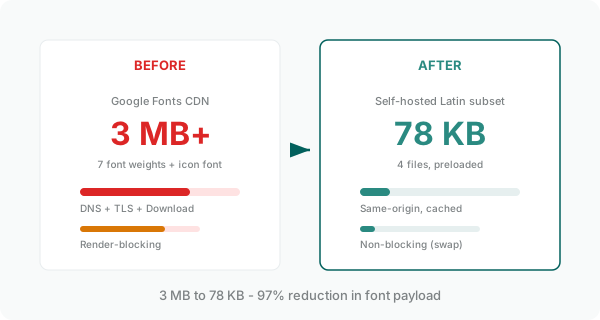
Before and after font optimisation - Google Fonts CDN at 3MB versus self-hosted Latin subset at 78KB

24 March 2026

We Dropped Google Fonts and Our Page Speed Score Jumped 30 Points

Two lines of HTML were loading over 3MB of font data on every visit. The culprit? A Japanese-origin typeface shipping its full CJK character set to an English-language page.

We self-hosted with Latin subsets, cut the payload to 78KB, and watched our Page Speed score jump from the mid-60s to 96. Here's exactly how we did it - and how to check if your site has the same problem.

Six dimensions of AI search readiness - spider chart showing direct answers, entity richness, citations, Q&A format, schema, and freshness

10 March 2026

AI Search Readiness: What Your Score Really Means

Your AI Search Readiness score measures how well-structured your content is for AI engines like ChatGPT and Perplexity. A high score does not guarantee you will appear in AI-generated answers - those responses are inherently variable and change with every query.

But a low score effectively guarantees you won't. If your content isn't structured for AI extraction, you're invisible to a growing share of your audience. We break down the six dimensions and what you can do about each one.

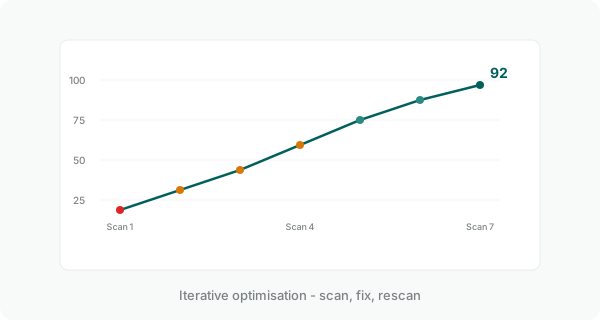
SEO score trending upward through iterative optimisation - scan, fix, rescan workflow

17 March 2026

The Scan-Fix-Rescan Loop: How to Maximise Your OptimAI Score

The most effective way to improve your score is simple: scan, fix the highest-impact suggestions first, then rescan to measure progress. Refreshes cost less than initial scans because you're tracking improvement, not discovering issues.

Pro tip: export the PDF report, feed it to your favourite AI along with your target page content, and let it work through the suggestions for you. We've seen pages jump 15+ points in a single session this way.

Ready to check your AI visibility score?

3 free analyses. No credit card. Your AI visibility audit in 30 seconds.

Get Started Free